A Selection of Quotes
2026-05-13
The Importance of Exercising Virtues Consistently, by Aristotle
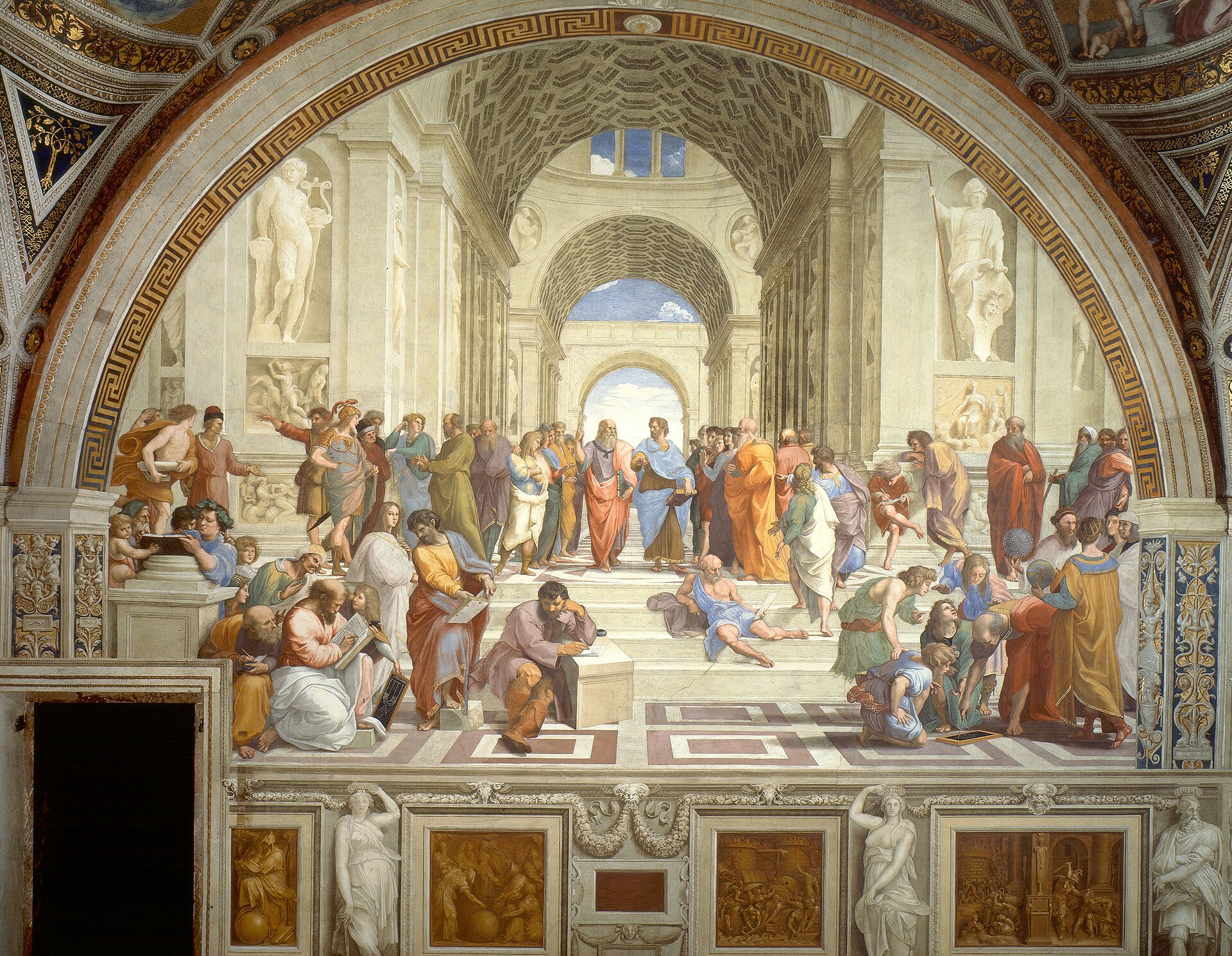 -- The School of Athens by Raffaello
Another point is that when we excise the virtues, we perform the same kind of actions that produce, increase, and even destroy them. That's the way it is in other very obvious examples, such as strength, which comes from eating a heavy diet and doing a lot of strenuous exercise. These are the very activities that a strong person is especially able to perform. It is with the virtues. For example, by refraining from pleasures we develop self-discipline, and once we have developed it, we are especially able to refrain from them. Bravery is the same. We become brave by getting used to making little of the things that frighten us and enduring them, and once we become brave we are especially able to endure frightening things.
Note from Laurence: I find this to be especially relevant in the digital age. Over the years, the allure of social media apps and other digital services have (at least in my experience) shaped how I choose to spend my time. Aristotle argues that the pursuit of virtues is accomplished by refraining from immediate pleasures, which in a 21st-century perspective stem from social media reels to sifting mindlessly through the Internet. The importance of foregoing immediate pleasures, accentuated by the web, and doing so consistently is imperative in the pursuit of the virtues.
The Rainbow, by Steve Jobs
The journey is the reward. People think that you’ve made it when you’ve gotten to the end of the rainbow and got the pot of gold. But they’re wrong. The reward is in the crossing the rainbow. That’s easy for me to say—I got the pot of gold (literally). But if you get to the pot of gold, you already know that that’s not the reward, and you go looking for another rainbow to cross.
Think of your life as a rainbow arcing across the horizon of this world. You appear, have a chance to blaze in the sky, then you disappear.The two endpoints of everyone’s rainbow are birth and death. We all experience both completely alone. And yet, most people of your age have not thought about these events very much [...] How many of you have seen the birth of another human? It is a miracle. [...] No human alive knows what happens to “us” upon or after our death. Some believe this, others that, but no one really knows at all. Again, most people of your age have not thought about these events very much, and it’s as if we shelter you from them, afraid that the thought of mortality will somehow wound you. For me it’s the opposite: to know my arc will fall makes me want to blaze while I am in the sky. Not for others, but for myself, for the trail I know I am leaving.
Now, as you live your arc across the sky, you want to have as few regrets as possible. Remember, regrets are different from mistakes. Mistakes are those things that you did and wish you could do over again. [...] In others you were scared. In others you hurt someone else. Some mistakes are deep, others not. But if your intent was pure, they are almost always enriching in some way. So mistakes are things that you did and wish you could do over again.
Bicycle for the Mind
I read a study that measured the efficiency of locomotion for various species on the planet. The condor used the least energy to move a kilometer. And, humans came in with a rather unimpressive showing, about a third of the way down the list. It was not too proud a showing for the crown of creation. So, that didn’t look so good. But, then somebody at Scientific American had the insight to test the efficiency of locomotion for a man on a bicycle. And, a man on a bicycle, a human on a bicycle, blew the condor away, completely off the top of the charts.
And that’s what a computer is to me. What a computer is to me is it’s the most remarkable tool that we’ve ever come up with, and it’s the equivalent of a bicycle for our minds.
On Systems
No one can define or measure justice, democracy, security, freedom, truth, or love.
No one can define or measure any value.
But if no one speaks up for them,
if systems aren’t designed to produce them,
if we don’t speak about them and point toward their presence or absence,
they will cease to exist.
On Robotics
While much of robotics is still in its infancy, the idea of “intelligent” manipulating devices has an enormous potential to change society.
Wouldn’t it be great if all our cars were able to safely steer themselves, making car accidents a notion of the past?
Wouldn’t it be great if robots, and not people, would [be able to operate in dangerous search and rescue missions]?
Wouldn’t it be great if our homes were populated by intelligent service robots that would carry out such tedious tasks as loading the dishwasher, and vacuuming the carpet, or walking our dogs?
And lastly, a better understanding of robotics will ultimately lead to a better understanding of animals and people.